
Synchrony invited me to open its Envision26 partner conference in Nashville with an unusual assignment: I had 30 minutes to make the audience question what they were seeing, then leave the conclusions to Synchrony’s experts. The conference theme was “What If?” and every speaker had a particular role in the program.
By the time CTL Communications reached out to me, they had already read dozens of my blog posts and watched many of my videos. They knew what I taught and how it aligned with their goals.
Synchrony was bringing together about 260 senior leaders from its retail and healthcare partner companies, many of them heads of marketing. The conference gave them a chance to exchange ideas with peers and hear Synchrony’s broader perspective on consumer behavior, the economy, and changes in their markets.
A Different Kind of Keynote
Normally, I deliver an hourlong keynote with a beginning, a middle, and an end. In this case, the organizers wanted me to do the beginning and middle, but not the end. They already had their own ending figured out.
Synchrony’s experts would spend the rest of the conference sharing market research, consumer insights, and ideas for growth. They wanted me to prepare the audience to approach those conversations with a different perspective.
Through three months of work and multiple Zoom meetings, I proposed several approaches before we narrowed them down to a question that connected directly with what I teach: “What If Perception Is Not Reality?”
We all know the familiar phrase “perception is reality.” What we perceive, we end up believing is real, and we act on it. Marketers know how much perceptions matter.
Many of the people in that room spend their careers shaping what customers notice and believe. I wanted to give them the experience of being on the receiving end of that influence, to show how magicians manipulate perceptions and how easily what we believe can differ from what is actually happening.
There was one additional challenge. The organizers wanted me to start a magic trick, pause in the middle, and reveal how it worked.
I understand why. In my Think Like A Magician™ keynote, I teach the psychology underneath the trickery, but I never expose how magic tricks work. Besides, great magic can involve multiple, carefully layered methods that make the audience’s experience far more interesting than any single secret.
I was willing to reveal one small method to give the audience a glimpse of how magicians influence choices while creating the perception of complete freedom. And even then, the end of the trick still left the audience astonished.
Three Acts About Perception
I organized the presentation around three examples of how perception shapes us: our immediate choices, the beliefs we share as a society, and the limits we place on ourselves.
The first act was about attention and awareness. Through an interactive demonstration, I showed how a magician can influence people’s choices by directing their focus. Audience members made decisions in front of their colleagues and saw how their own attention could affect what they believed.
The second act was the story of the Turk, the famous chess-playing automaton that convinced people a machine could accomplish something extraordinary. I explored how people could believe the wrong explanation for what they were seeing, and how believing something is possible can inspire people to attempt things they previously thought impossible.
For the third act, I shared my own experience learning to solve a Rubik’s Cube. I’d avoided it most of my life because I assumed you had to be a mathematical genius to solve one. When I finally challenged that assumption, I learned that I simply needed to read the instructions, follow the steps, and learn the algorithm. I was shocked that I’d let an assumption keep me from trying for so long.
Making the Experience Personal
Creating this presentation meant understanding Synchrony’s business, the conference, the people in the room, and what the organizers wanted attendees to think, feel, and do afterward.
One of the companies represented at the conference was a place where I’m a customer. I went to their location in Central Florida and filmed a custom video for one of the tricks.
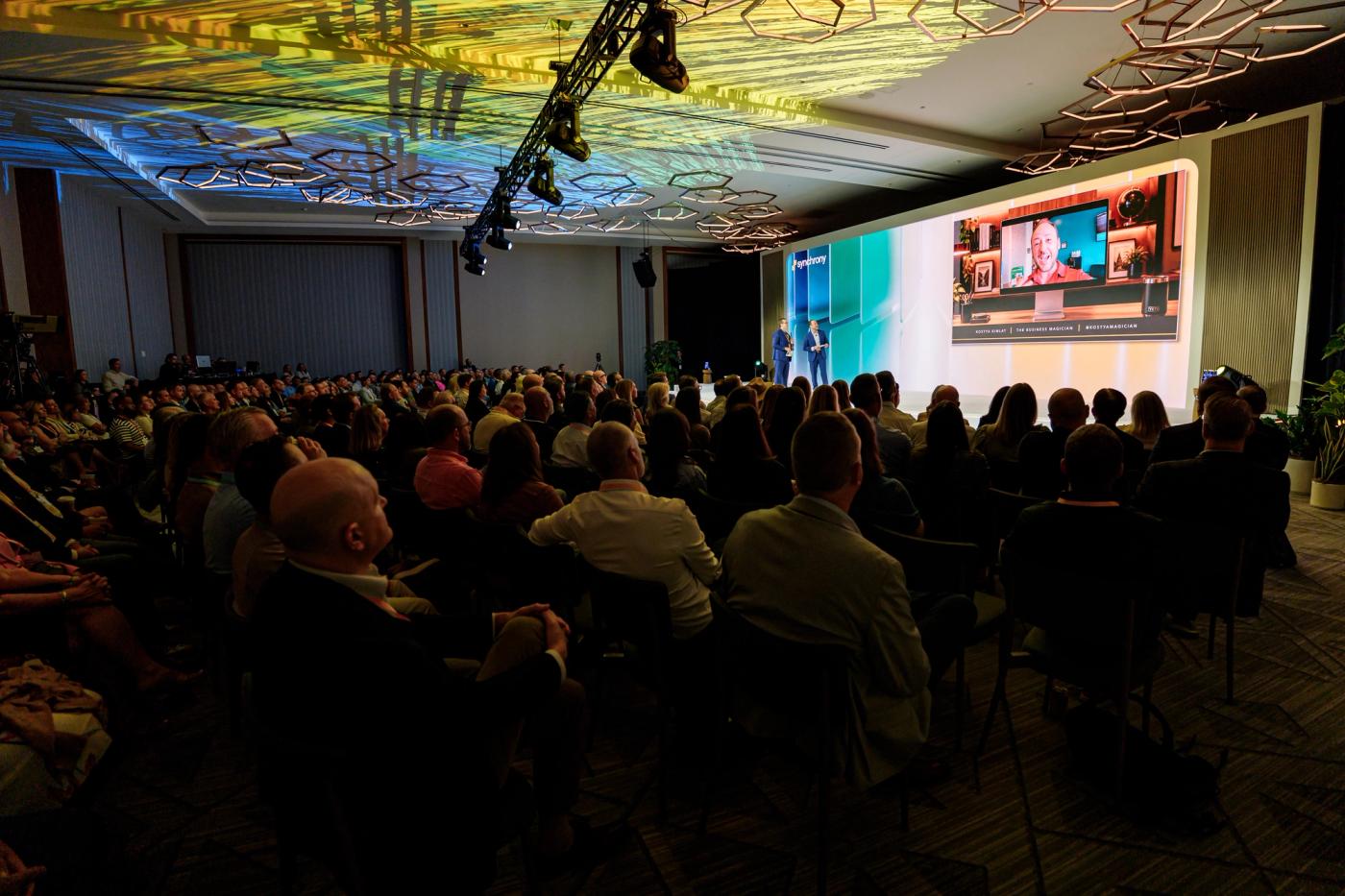
During the keynote, I had audience members calling out their company names, and the video became part of a moment that surprised the room. The people from that company were among the loudest.
I spent more than 60 hours preparing this 30-minute keynote. Cutting my stage time from an hour to half an hour meant spending more time deciding what belonged in the presentation. Because the material was created specifically for this audience, I couldn’t test it at other conferences. I worked with my team and brought in outside perspectives as I developed and rehearsed it.
I worked closely with Chris Marmion and Catherine Turner at CTL Communications, along with Colleen Stanard and the team at ALBOE Meetings & Events. The production team helped coordinate the staging, media, and technical details that brought the presentation together.
By the time I walked onstage, I’d rehearsed the material so thoroughly that I didn’t need a single word of notes on my confidence monitors. I could be fully present with the audience.
When You’re Being Fooled and Don’t Know It
One of the things I love about magic is the emotional experience it creates. People feel astonishment, confusion, curiosity, and wonder. They remember those feelings because they’ve experienced something they can’t explain.
And they experience all of this in a safe place of honesty, because I’m a magician and I tell them so.
When I perform magic, the audience knows it’s being fooled because something seemingly impossible happens right in front of them. But in business, you don’t know when you’re being fooled. The numbers look good, people agreed in the meeting, and everything seems plausible, so nobody questions the assumptions underneath.
That was the lesson I wanted the audience to carry into the rest of the conference: to recognize how attention, awareness, and assumptions influence what we believe, and to ask better questions before making decisions.
Synchrony could then show its partners the research, data, and perspectives that would help them better understand their buyers and their markets.
I ended my presentation with the same question I’d started with: “What If Perception Is Not Reality?”
When Synchrony’s speakers took the stage, they picked up the theme of perspective and began exploring their insights about the economy and consumers.
The Results
The comment I often hear after speaking is that people expected to have fun and be entertained, but didn’t expect to learn so much.
At Envision26, dozens of people stopped me in the hallways and during breaks to talk about the presentation. Afterward, the organizers asked whether they could share the session video and slides internally because so many attendees had requested them. A few weeks later, another company reached out about bringing me to its own conference after two of its executives had seen my keynote.
I hope that months or even years from now, someone from that audience will remember what they experienced that morning. Maybe they’ll question an assumption they would have otherwise accepted, or attempt something they’d always believed was impossible. I’ll probably never know about those moments, but the possibility that 30 minutes together could change how someone thinks or what they decide to do next makes all that preparation worthwhile.